
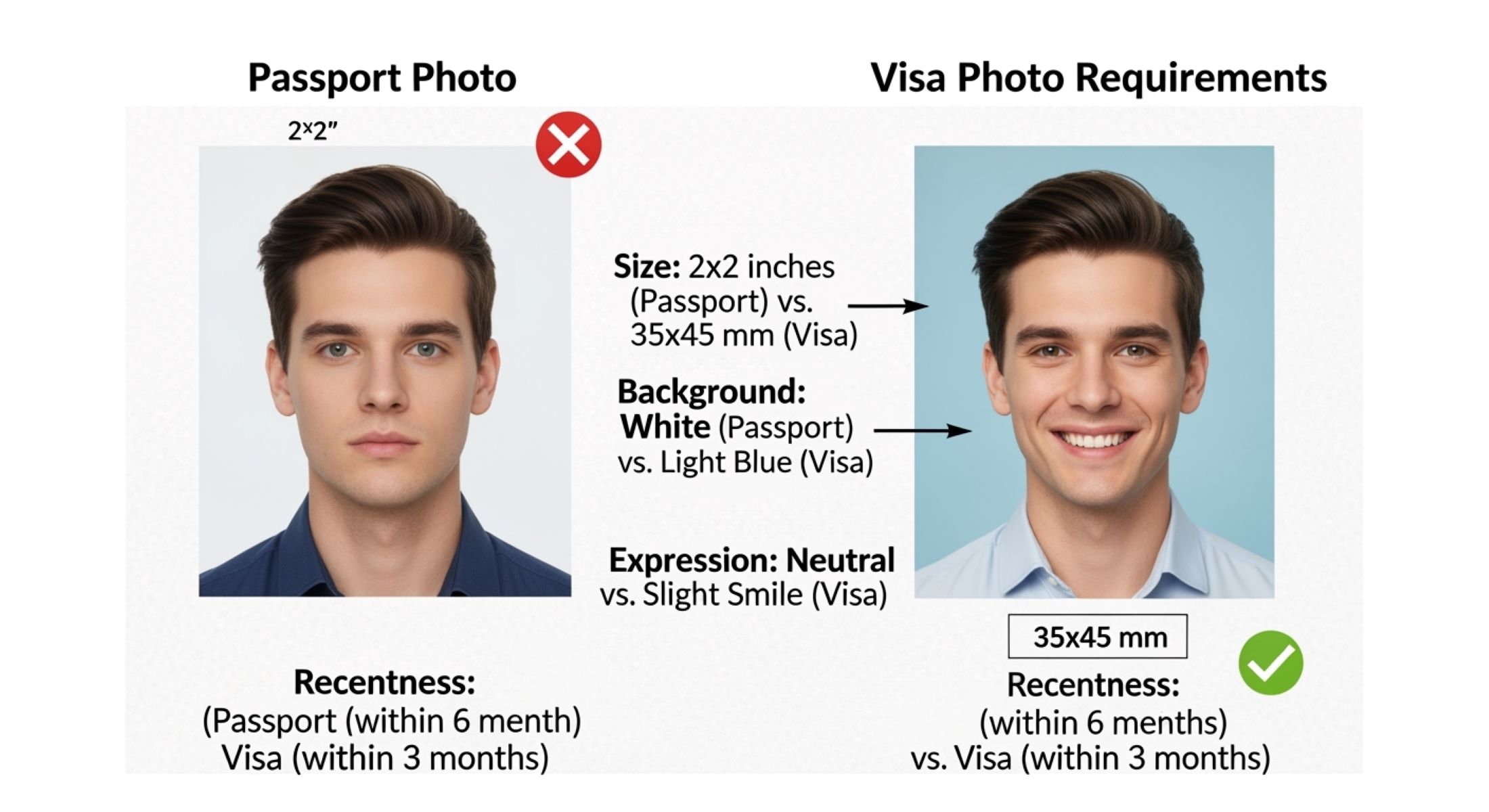
When it comes to traveling abroad, one of the most overlooked yet crucial details is the photo requirement. Whether you’re applying for a passport or a visa, that tiny photo you attach can make or break your application. But here’s the question that confuses many travelers—are passport photos and visa photos the same thing, or do they differ in requirements? Let’s break it down in a simple, conversational way so you won’t be caught off guard next time you’re preparing travel documents.
Understanding the Basics of Travel Document Photos
Travel document photos, whether for passports or visas, are far more than just a snapshot of your face. They serve as the primary means of verifying your identity across borders, making them a critical part of the application process. These photos are scrutinized to ensure that the person applying for the travel document is indeed the same person who will be using it. Unlike casual photographs, travel document photos must adhere to precise rules regarding size, background, expression, and even lighting. Governments rely on these standards to maintain consistency and accuracy, making it easier to compare your photo against your appearance at airports, border checkpoints, and immigration offices.
One of the key purposes of these photos is identity verification. Border authorities often have only seconds to confirm a traveler’s identity, and a properly formatted photo ensures that facial recognition systems or manual checks can work efficiently. Even minor deviations in facial expression, head position, or background color can make it difficult for automated systems to recognize you. Think of these photos as a digital fingerprint—slight variations can create mismatches, potentially causing delays or even denial of entry.
Another important role of travel document photos is fraud prevention. With the increasing sophistication of identity theft and document forgery, governments worldwide have established strict biometric standards for these images. A properly captured photo helps immigration officials detect inconsistencies, such as altered features or digitally manipulated images. The requirements also cover technical details, like photo resolution, lighting, and even file format in the case of digital submissions. These standards act as a safeguard to protect both the traveler and the integrity of national borders.
Finally, travel document photos are essentially a universal key that unlocks access to international travel. Just like a key must perfectly fit a lock to open a door, your photo must meet all requirements to ensure your application is processed smoothly. Even small mistakes, such as shadows, blurry edges, or incorrect sizing, can create unnecessary hurdles. Understanding the basics of these photos—and why they are so meticulously regulated—helps travelers appreciate the importance of investing time and care into this seemingly small but critical step in the journey of global mobility.
Are Passport and Visa Photos Always the Same?
| Feature/Aspect | Passport Photos | Visa Photos | Similarities | Key Differences |
| Purpose | Serves as a long-term identification document for travel | Serves as proof of identity specifically for entry permission | Both are used for identity verification | Visa photos often have stricter entry-specific rules |
| Size/Dimensions | Typically standardized by issuing country (e.g., 2×2 inches in the U.S., 35×45 mm in the EU) | Varies by country and embassy; may match passport or differ (e.g., Schengen visas 35×45 mm) | Often require a clear headshot of the full face | Visa photo sizes can differ from passport and vary by embassy |
| Background | Plain white or off-white | Usually white; some embassies allow light gray or blue backgrounds | Both must avoid patterns, shadows, or objects | Some visa applications specify exact shades or lighting requirements |
| Format & Submission | Printed photo, sometimes with digital upload for e-passports | Often both printed and digital; e-visas usually require digital submission | Both require high-quality, clear images | Visa photos often have specific file formats, resolution, and cropping rules |
| Quantity Needed | Usually 1–2 copies | Varies by embassy, often 2–4 copies | Both may require multiple copies | Visa applications frequently require more copies than passports |
Common Similarities Between Passport and Visa Photos
- Recency of the Photo – Both passport and visa photos must be recent, usually taken within the last six months. This ensures that your appearance in the photo closely matches your current look, including hairstyle, facial hair, and any other changes. Using an old photo can lead to rejection because border officials need to verify your identity accurately.
- Full Face Visibility – The entire face must be clearly visible from the top of the forehead to the bottom of the chin. Both passport and visa photos require your face to be fully exposed without any obstructions such as hair covering your eyes or large accessories. This visibility allows for both manual verification by officials and automated facial recognition software to work effectively.
- Neutral Expression – A neutral facial expression is mandatory in both types of photos. Smiling, frowning, or raising eyebrows can distort facial features, making recognition difficult. A relaxed, closed-mouth expression with eyes open is universally accepted and helps maintain uniformity across all travel documents.
- Plain Background – The background of both passport and visa photos must be plain and light-colored, usually white or off-white. This eliminates distractions and provides a clear contrast with your face, allowing immigration authorities to focus solely on your features. Shadows, patterns, or textured backgrounds are typically not accepted.
- High Resolution and Clarity – Both types of photos must be of high resolution, free from blurs, pixelation, or distortions. Clear images are essential to ensure that facial details are accurately captured, which is particularly important for biometric verification systems used in many countries.
- No Filters or Digital Alterations – Filters, retouching, or any digital alterations are strictly prohibited in both passport and visa photos. The image must represent your natural appearance without enhancements that could interfere with official identification.
- Proper Lighting – Consistent and even lighting is required for both types of photos. Harsh shadows, bright spots, or uneven light can obscure facial features and lead to rejection. Natural or studio lighting is preferred to produce a well-lit and balanced image.
Key Differences Between Passport and Visa Photos
While passport and visa photos share many basic requirements, the differences between them can be significant and often lead to confusion for travelers. One of the primary distinctions lies in size and dimensions. Passport photos are usually standardized by the issuing country—for example, U.S. passports require a 2×2 inch photo, while many European countries use 35×45 mm. Visa photos, on the other hand, vary widely depending on the destination country and the type of visa being applied for. Schengen visas, for instance, generally require a 35×45 mm photo, whereas U.S. visa applications may still use the 2×2 inch format. This variation in size is one of the most common reasons applicants accidentally submit an incorrect photo.
Another important difference concerns the background and head coverage. Passport photos almost universally require a plain white or off-white background, keeping the focus solely on the applicant’s face. Religious headwear is permitted as long as the face is clearly visible. Visa photos, however, can have more stringent or specific rules depending on the embassy or consulate. Some countries accept light gray or blue backgrounds, and others may enforce stricter rules regarding head coverings to ensure full facial visibility. These nuanced differences often catch travelers off guard, especially when they assume that passport rules automatically apply to visas.
Glasses and other facial obstructions also highlight the contrast between passport and visa photos. Since 2016, U.S. passport photos do not allow glasses, but some visa offices still accept them if there is medical proof. This illustrates how even small variations can create issues if applicants are unaware of the specific requirements. Similarly, printed versus digital formats can differ. Passport photos are typically printed on high-quality matte or glossy paper, while many visa applications, especially e-visas, require digital photo uploads with strict file size, resolution, and format standards. Understanding these technical distinctions is crucial for ensuring that your application is not rejected.
Finally, the number of photos required can differ significantly. Passport applications usually ask for one or two copies, enough to process the document without excess. Visa applications, however, often require more—sometimes two to four photos, depending on the embassy and visa type. This requirement is especially common for countries that need multiple copies for different processing stages or consular offices. Travelers who fail to provide the correct quantity risk delays or even denial of their visa. In essence, while passport and visa photos appear similar at first glance, their detailed specifications differ in ways that can have a major impact on the success of your application.
Why Countries Set Different Standards
| Country/Region | Passport Photo Standards | Visa Photo Standards | Biometric/Technical Requirements | Key Notes/Reasoning |
| United States | 2×2 inches, plain white background, no glasses since 2016 | Same size; digital upload required for some e-visas | Strict biometric standards for facial recognition | Ensures identity verification and fraud prevention |
| Schengen Area (EU) | Varies by country (35×45 mm common for some passports) | Uniform 35×45 mm for all visas | Standardized biometric data for visa processing | Uniformity across member states simplifies travel checks |
| India | 2×2 inches, plain background, printed photo preferred | Digital JPEG upload for e-visas, specific pixel size | Some embassies require digital verification | Flexibility for both traditional and electronic submissions |
| China | 33×48 mm, plain background | Often four copies, strict color and size requirements | May require digital scans for consular processing | Extra copies needed for multiple processing stages |
| Japan | 35×45 mm, neutral expression | Light blue or white background, digital or printed | Facial recognition used for visa approval | Minor background differences reflect national guidelines |
Passport Photos: The Standard Rules
- Size and Dimensions – Passport photos must adhere to the specific size standards set by the issuing country. In the U.S., the required size is 2×2 inches (51×51 mm). The U.K. typically uses 35×45 mm, while Canada requires a larger format of 50×70 mm. These sizes are strictly enforced, and submitting a photo that doesn’t meet the exact dimensions can result in delays or rejection of your application.
- Pose and Facial Expression – A neutral expression is mandatory for passport photos. Applicants should keep their eyes open and face directly toward the camera. Smiling with teeth, tilting the head, or looking sideways is not allowed. The goal is to capture a true, natural representation of your face that can be recognized easily by officials and biometric systems.
- Head Positioning and Framing – Your head should be centered and occupy a specific proportion of the photo, typically between 70-80% of the frame. The photo must show the full head, including the top of the hair and the chin, with the shoulders slightly visible. Proper framing ensures accurate identification and supports facial recognition technology used in many countries.
- Background Requirements – Passport photos must have a plain, light-colored background, usually white or off-white. Shadows, patterns, or textured backgrounds are not accepted. This simplicity allows authorities to focus on the face without distractions and ensures consistent contrast for scanning or digital processing.
- Lighting and Clarity – Even lighting is critical to avoid shadows on the face or background. The image must be in sharp focus, clear, and high resolution. Overexposed or underexposed photos, or those with glare, can be rejected by passport authorities.
- Clothing Rules – Applicants should avoid wearing uniforms, camouflage, or clothing with busy patterns. Simple, everyday attire is preferred. Religious attire is generally permitted as long as it does not cover the face or obscure facial features. This ensures consistency while respecting cultural and religious practices.
- Accessories and Obstructions – Hats, sunglasses, and other accessories that block the face are not allowed. Eyeglasses are generally prohibited in U.S. passport photos unless medically necessary, and any head covering must still allow the full face to be visible. Removing such obstructions ensures that the facial features are clearly captured.
- Color and Image Quality – Passport photos must be in color, not black and white, to provide accurate representation of skin tone, hair color, and eye color. Photos must be free of filters, retouching, or digital enhancements that could alter natural appearance.
- Consistency Across Copies – If multiple copies of the passport photo are required, all must be identical in appearance, lighting, and expression. Inconsistent photos can cause confusion or delays in the application process.
- Recent Appearance – The photo should reflect your current appearance, ideally taken within the last six months. Major changes in hairstyle, facial hair, or other distinguishing features can render the photo unacceptable for official identification purposes.